Small Everyday Strains Can Be Hard on an Older Heart
Learn which everyday situations can add cardiovascular strain, the heart attack and cardiac arrest signs families should recognize, and when to call 911.
AI-generated editorial illustration for Still Talking.
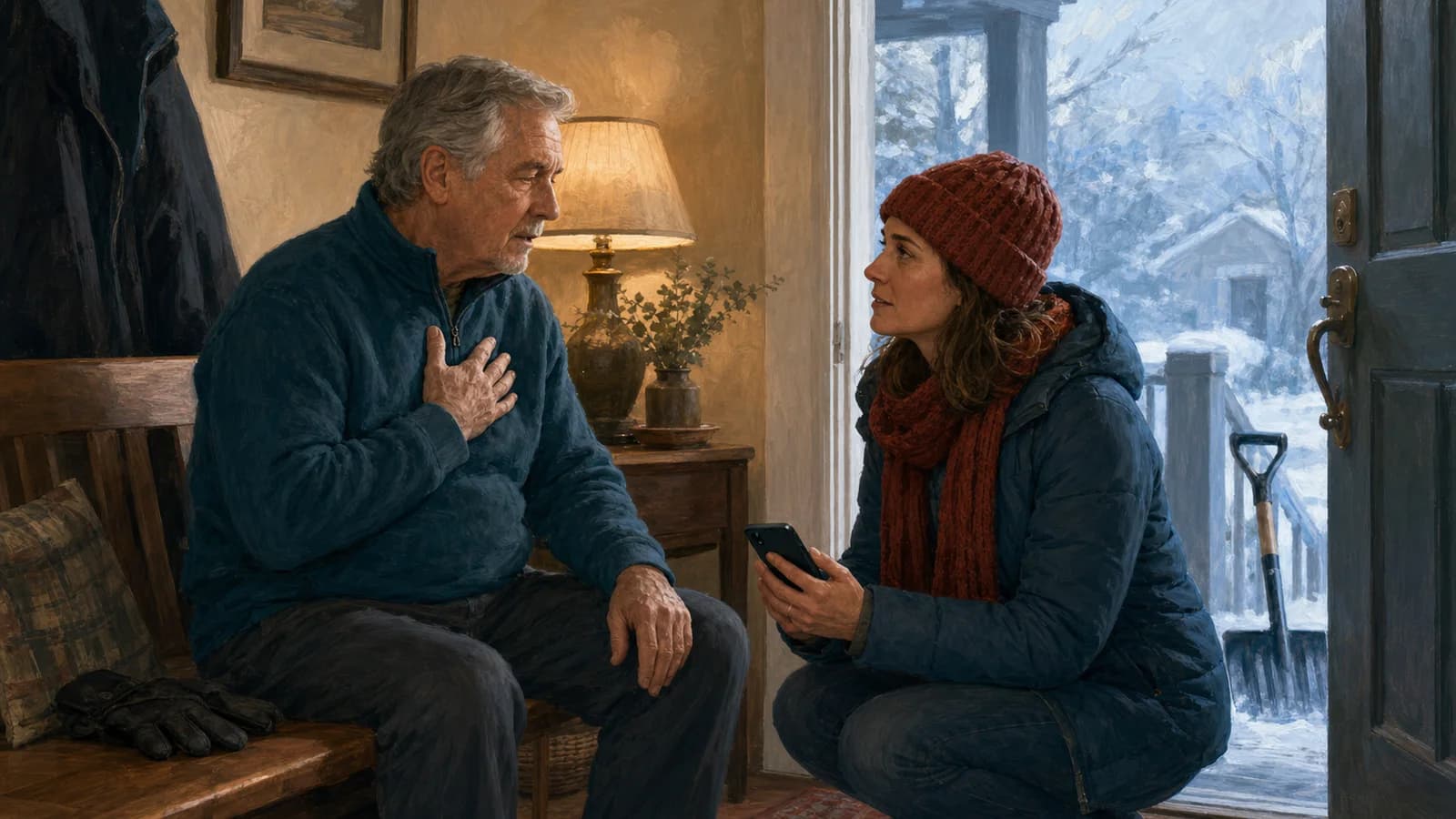
Your father comes in after clearing a thin layer of snow from the front steps. He sits down before taking off his coat. One hand rests on the center of his chest.
He says he only needs a minute.
You have two competing instincts. One says not to overreact. The other says this is exactly how families lose time: someone feels pressure, breathlessness, nausea, or unusual weakness, and everyone waits for it to pass.
Ordinary activities are easy to blame after a frightening event. A hot shower, a difficult bowel movement, getting out of bed quickly, or working outside in cold weather can change blood pressure, heart rate, or the body's demand for oxygen. But these activities are usually not a single, independent cause of sudden death. The more useful question is whether the activity exposed an underlying problem and whether the person is showing warning signs now.
This article is an evidence-checked English adaptation of a Chinese-language public-health commentary supplied to Still Talking. Its strongest idea is worth keeping: do not dismiss symptoms because they appeared during an ordinary part of the day. Some original claims were revised to match current U.S. evidence and emergency guidance.
Heart attack and cardiac arrest are not the same event
A heart attack is a circulation problem. Blood flow to part of the heart becomes blocked, and heart muscle begins to be damaged. A person having a heart attack may be awake, speaking, and breathing.
Cardiac arrest is an electrical problem. The heart suddenly stops pumping effectively. The person becomes unresponsive and is not breathing normally or is only gasping. A heart attack can lead to cardiac arrest, but the terms are not interchangeable.
That difference changes what the family should do. Possible heart attack symptoms require an immediate call to 911. Suspected cardiac arrest requires 911, cardiopulmonary resuscitation (CPR), and an automated external defibrillator (AED) as soon as one is available.
Do not drive someone with possible heart attack symptoms to the hospital if emergency medical services are available. Paramedics can begin treatment on the way, and the person's condition can deteriorate without warning.
Four ordinary situations that deserve context
The goal is not to make a list of forbidden activities. It is to notice when an everyday situation adds stress to a body that may already be vulnerable.
Straining in the bathroom. Holding the breath and bearing down can briefly change blood pressure and heart rate. Constipation is also common in older adults and can be affected by medications, hydration, diet, and activity. Rather than treating the toilet as inherently dangerous, discuss repeated constipation, dizziness, fainting, chest discomfort, or palpitations with a clinician. Do not start laxatives or change medication on someone else's behalf without checking what is appropriate for them.
Standing up quickly. Blood pressure can fall when a person rises, causing lightheadedness or fainting. Sitting at the edge of the bed for a moment and standing with support may reduce fall risk. Recurrent dizziness is not just an inconvenience; it deserves a medication and health review.
Very hot rooms, showers, or weather. Heat makes the body work harder to cool itself and can contribute to dehydration. Risk varies with age, health conditions, medicines, temperature, and exposure time. A warm shower is not a medical emergency, but faintness, chest pressure, confusion, or unusual shortness of breath should not be explained away as “just the heat.” Our guide to summer heat and an aging parent offers a practical family plan for hot days.
Cold weather plus sudden exertion. Cold narrows blood vessels and can raise blood pressure. The American Heart Association warns that sudden exertion in the cold, including snow shoveling, can place extra strain on the heart. Someone who is usually inactive or who has known cardiovascular risk should not use the first storm of the year as a fitness test. Stop immediately if symptoms begin.
None of these points means a family should patrol the bathroom door, control the thermostat without consent, or prohibit every winter chore. Fear can quickly turn concern into control. A better plan pairs a few sensible adjustments with a shared understanding of the warning signs.
Heart attack warning signs in older adults
Chest pressure, squeezing, fullness, or pain is the best-known warning sign, but it is not the only one. According to the CDC, possible heart attack symptoms include:
- pain or discomfort in the jaw, neck, back, arm, or shoulder;
- shortness of breath;
- feeling weak, lightheaded, or faint;
- a cold sweat;
- unusual or unexplained tiredness; and
- nausea or vomiting.
Symptoms can be mild, can come and go, and do not always look dramatic. Women are more likely than men to have symptoms such as unusual tiredness, nausea, or vomiting, though anyone can have them.
If these symptoms are new, unexplained, or concerning, call 911. Do not wait for the person to “look sick enough,” and do not spend precious time searching online for reassurance. Emergency dispatchers can help decide what to do next.
If the person becomes unresponsive
If an adult suddenly collapses, does not respond when you tap and shout, and is not breathing normally or is only gasping, assume cardiac arrest.
Call 911 and put the phone on speaker. Send someone to get an AED if one is nearby. Begin hands-only CPR by pushing hard and fast in the center of the chest, following the dispatcher's instructions. Use the AED as soon as it arrives; it will analyze the heart rhythm and give spoken directions.
You do not need to diagnose the cause before acting. Early CPR keeps blood moving to the brain and other organs, while early defibrillation can restore a shockable rhythm. A CPR class is one of the few forms of family preparedness that can turn panic into a rehearsed response.
Prevention is a plan, not a collection of rigid rules
The biggest opportunities are usually not dramatic. They are consistent management of blood pressure, cholesterol, diabetes, smoking, activity, medication, and follow-up care. A clinician can help adapt those priorities to a person's diagnoses and capacity.
It is also important not to replace individualized care with universal testing. For adults without symptoms and at low cardiovascular risk, the U.S. Preventive Services Task Force recommends against screening with a resting or exercise electrocardiogram because false-positive findings can lead to unnecessary procedures and harm. For people at higher risk, evidence is not sufficient to recommend one screening rule for everyone. Symptoms, medical history, family history, physical findings, and a clinician's judgment should guide testing.
That means a new episode of chest pressure, fainting, palpitations, or declining exercise tolerance should be evaluated. It does not mean every healthy adult needs the same heart test on the same annual schedule.
Make the family conversation specific
“Be careful” is too vague to use in an emergency. “You cannot do that anymore” is likely to start a fight. Try agreeing on observable actions instead:
“I am not asking you to stop living normally. I want us to agree that if you have new chest pressure, unusual shortness of breath, fainting, or a cold sweat, we call 911 instead of waiting. And if you keep getting dizzy when you stand, we bring that to your next appointment.”
Then make the plan easy to follow. Confirm the home address is visible near the phone. Learn where the nearest AED is at church, the community center, or the gym. Keep an updated medication list and emergency contact in a place both people can find. Take a CPR class together if your parent is willing.
This is a family communication problem as much as a health-information problem. The aim is not constant surveillance. It is a clear agreement about the few signs that change an ordinary day into an emergency.
Small routines do not need to become sources of dread. They should become prompts to pay attention: slow down when dizzy, stop when symptoms begin, discuss recurring changes with a clinician, and call 911 when warning signs point to a possible heart attack or cardiac arrest.
AI-generated editorial illustration for Still Talking.
Sources & further reading
- About Heart Attack Symptoms, Risk, and RecoveryCenters for Disease Control and Prevention
- What Is Cardiac Arrest?American Heart Association
- Adult Basic Life SupportAmerican Heart Association
- Cold Weather and Cardiovascular DiseaseAmerican Heart Association
- Cardiovascular Disease Risk: Screening With ElectrocardiographyU.S. Preventive Services Task Force
Send a calmer version of the conversation
Download a concise card to share with someone you care about.